
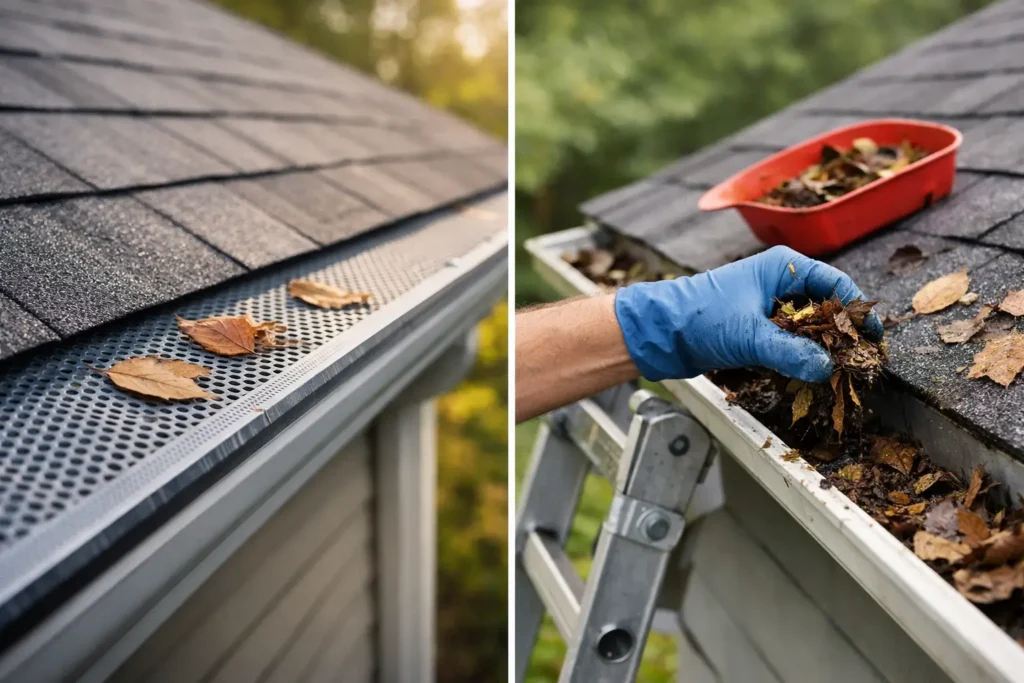
A gutter can look perfectly fine from the ground while holding wet leaves, roof grit, moss, and standing water just out of sight. By the time you notice an overflow running down the wall, the problem may already be affecting your siding, fascia boards, foundation, or garden beds. That is why homeowners often ask about gutter guards versus cleaning: is it better to install a guard, or simply arrange regular professional cleaning?
The honest answer is that gutter guards can reduce the amount of debris entering your gutters, but they are not a replacement for maintenance. The right choice depends on the trees around your property, the roof design, the type of guard, and how much hands-on upkeep you want to avoid.
What gutter guards are designed to do
Gutter guards sit over or inside the gutter channel to block larger debris while allowing rainwater to pass through. They come in several forms, including mesh screens, foam inserts, brush-style guards, and solid surface covers that guide water into the gutter through a narrow opening.
Their main benefit is prevention. A well-fitted guard can stop a heavy layer of leaves from settling in the gutter and forming a blockage. This is particularly useful for homes near mature trees, where autumn leaf fall can quickly fill open gutters.
Guards can also make a gutter system less inviting for birds and reduce the amount of material that needs to be removed during a cleaning visit. For homeowners who are tired of seeing downpipes back up after every windy week, that sounds like a straightforward fix.
But the wording matters: less debris is not the same as no debris. Small particles, seeds, roof moss, pine needles, and airborne dirt can still settle on top of a guard or work their way through it. Water also carries fine roof grit into the system over time.
Gutter guards versus cleaning: the real difference
Gutter cleaning deals with what is already in the system. A professional removes debris from the gutter runs, checks the outlets, clears the downpipes where needed, and makes sure water has a clear route away from the roofline.
Gutter guards aim to slow the buildup before it starts. They are a product investment, while cleaning is an ongoing maintenance service. One is not automatically better than the other because they solve slightly different problems.
For many homes, regular cleaning is the most practical and cost-effective answer. It gives you a clear view of the gutter condition and can reveal loose clips, sagging sections, damaged joints, or signs that water has been spilling over. Those issues can remain hidden beneath a guard until they become more serious.
A guard may be worthwhile when a property has a high volume of leaf debris and the guttering is otherwise in sound condition. Even then, it should be viewed as a way to extend the time between cleanings, not as permission to forget about the gutters completely.
When gutter guards can be a good investment
Gutter guards tend to make the most sense where leaves repeatedly collect faster than a homeowner can manage them. A detached house surrounded by deciduous trees, for example, may benefit from a quality mesh guard that keeps broad leaves out while allowing most rainwater through.
They can also help on awkward rooflines where access is difficult. If cleaning requires working around extensions, conservatories, or steep ground, reducing the amount of debris in the gutter can be useful. It may make each future maintenance visit quicker, although the guards still need to be inspected and cleared from above.
The type of debris matters. Larger leaves are easier for guards to block than fine debris. If your roof regularly sheds moss, pine needles, seed pods, or shingle grit, a guard can become a surface where that material gathers. In these cases, water may skim over the top of the guard during heavy rain instead of entering the gutter properly.
Installation quality matters just as much. A poorly fitted guard can lift in strong winds, interfere with the roof edge, or create gaps that trap debris. Before paying for an installation, it is sensible to have the existing gutters checked. There is little value in covering a system that already has leaks, poor falls, or blocked downpipes.
Why routine cleaning remains essential
Cleaning gives your gutter system the attention it needs, not just a surface-level solution. Debris is removed directly, and the cleaner can identify whether water is moving freely through the downpipes. This is especially valuable after periods of heavy rain, storms, or leaf fall.
A clean gutter protects more than the roof edge. When water overflows consistently, it can mark exterior walls, soak soil near the foundation, stain patios, and contribute to damp issues around vulnerable areas. Wooden fascia boards are particularly at risk when overflowing water is allowed to run behind or over them repeatedly.
There is also a safety point. Climbing ladders to reach gutters is one of those jobs that can look simple until the ground is uneven or the ladder needs to be repositioned around an extension. A professional service has the equipment and experience to reach elevated areas safely and assess the full system from end to end.
For many homes in Canvey Island and nearby Essex towns, an annual clean is a sensible baseline. Properties with overhanging trees, visible moss growth, or frequent windblown debris may need attention twice a year, often in late autumn and again in spring.
The hidden costs to consider
It is easy to compare the up-front price of guards with the cost of a cleaning appointment, but the long-term picture is more useful. Gutter guards can cost more initially, especially where there are multiple roof levels or long runs of guttering. They may reduce future cleaning needs, but they still require inspection and occasional clearing.
Cleaning has no installation cost and lets you adjust the schedule based on your property. If your home has few nearby trees and your gutters stay relatively clear, paying for guards may not provide enough benefit to justify the expense. A planned cleaning service could be all you need.
There is also the risk of false confidence. Some homeowners install guards and leave the gutters unchecked for years, only to find compacted debris underneath, a blocked downpipe, or water overflowing over the guard. Repairs to fascia, soffits, exterior finishes, and gutter brackets can quickly cost more than routine care.
How to choose the right approach for your home
Start by looking at the pattern, not one bad week. If you are regularly seeing leaves packed into the gutters, water spilling over during rain, or downpipes that drain slowly, you need a proper clean and inspection first. That will show whether guards are likely to help or simply cover up a maintenance issue.
If the main problem is large leaves from nearby trees, quality guards may reduce the amount of debris that enters. Plan on having them checked periodically, particularly after autumn and storms. If the problem is moss, fine grit, or a gutter system that is already poorly pitched, regular cleaning and repair work are usually the stronger first step.
Consider your priorities as well. Some homeowners want the lowest ongoing cost. Others would rather invest in a guard to reduce the frequency of maintenance. Both are reasonable choices when the decision is based on the property rather than a one-size-fits-all promise.
A practical maintenance plan
Whether you choose guards, cleaning, or both, watch for warning signs between scheduled visits. Overflowing water, plants growing from the gutter, staining below the roofline, damp patches near exterior walls, and sagging gutter sections all deserve prompt attention.
A professional gutter clean should leave the channels and outlets clear, with visible results you can trust. Essex Exterior Cleaning provides fully insured exterior maintenance with the practical equipment needed to care for hard-to-reach guttering safely. If your gutters have not been checked since last leaf fall, arranging a clean now can prevent a small blockage from becoming a costly repair later.